Friday, 1 May 2009


Friday, 24 April 2009
From 'The Quaker Graveyard in Nantucket' by Robert Lowell (1917-1977)

There once the penitents took off their shoes
and then walked barefoot the remaining mile,
And the small trees, a stream and hedgerows file
Slowly along the munching English lane.
Like cows to the old shrine, until you lose
Track of your dragging pain.
The stream flows down under the druid tree.
Shiloah's whirlpools gurgle and make you glad
And whistled Sion by that stream. But see:
Our Lady, too small for her canopy,
Sits near the altar. There's no comeliness
At all or charm in that expressionless
Face with its heavy eyelids. As before,
This face, for centuries a memory.
Non est species, neque decor
Expressionless expresses God: it goes
Past castled Sion. She knows what God knows,
Not Calvary's Cross nor crib at Bethlehem
Now, and the world shall come to Walsingham.
Tuesday, 21 April 2009
Birdman of Delamere Terrace: Clifford Coffin's portraits of Lucian Freud
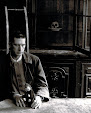
Clifford Coffin established his reputation as a fashion photographer, and his work was regularly featured in the pages of Vogue throughout the late forties and fifties. He was commissioned by the magazine to photograph the young Lucian Freud, and the resulting session took place on March 18th, 1947, immediately after the artist's five-month sojourn on Poros at the invitation of John Craxton. The pair had taken two upstairs rooms in a lodging house on the island, and they lived on virtually nothing, save for occasional handouts from Freud's parents. It was an excellent location in which to paint, and to escape the rigors of a Britain still in immediate post-war austerity. Greece, however, was experiencing the horrors of a civil war, and extreme privation amongst its own citizens, and there remained guerrilla activity close by. His stay on Poros was the longest time that Freud had been away from London since arriving there as a ten-year old in 1933. Back in London, Freud experienced the coldest winter in living memory, but had a handful of small paintings to show for his time in the Greek sunshine- sufficient for a show at ELT Messens's gallery the following year. The Studio was to comment of the resulting show- which he shared with the then-more saleable Craxton- that [Freud] 'Continues to display a curious mind'. By then, he had found a muse in Jacob Epstein's daughter Kitty Garman, and his early portraits of her, particularly in the infamous Girl with Kitten display an powerful sense of attraction and desire. However, when the session with Coffin was mooted, the show, and a subsequent trip to the South of France with Graham and Kathleen Sutherland were in the future. Rather, he was still settling back into the routine of London and contending with the privations of a cold first-floor room in Delamere Terrace in Paddington. The north light from the canal made it a good painting studio, and he had lived there since 1943. It was the setting for 'The Painter's Room', begun in 1943 and still wet on the easel when the area was hit by a buzzbomb, and was also the room in which Freud painted Harry Diamond for Interior in Paddington, the iconic image commissioned by the Arts Council for the 1951 Festival of Britain.

Feaver goes on to state that the Coffin session coincided with a turning point in Freud's career, and the young painter 'began to realise that his future as a painter would have to involve greater risk. Bacon inspired and provoked this in him'. Now, however, before the lens, fresh from his Greek idyll, we can see his latest works in some of the photographs, and wearing the sweater (Feaver says 'calculatingly' so) in which he had fitted himself out for a spell on a North Atlantic convoy in 1941 and where he had sailed to Nova Scotia and back. A severe bout of tonsillitis meant a discharge for him, and a resulting painting Hospital Ward was made during his convalescence. Feaver states that the Greek paintings proved to be the culmination of what may be identified as Freud's early manner style. The famous zebra head was dumped unceremoniously on the landing of Delamere Terrace, and the sparrowhawk was taken to Essex one weekend and left with friends near Chelmsford.
I am fortunate to have been given a contemporary print of one of these iconic photographs, which includes in the shot, Freud's Portrait of a Young Man prominently displayed on the easel. Freud looks out towards Coffin's lens and cradles the sparrowhawk with an air of studied ease, whilst surrounded by the paraphanalia of his painting equipment. The William Feaver article of 2002 published a series of the Coffin photographs for the first time, and it is worth investigating a back issue of the publication in order to gain an impression of power of the photographs and the subject's presence in them. Coffin's photographs of the young Freud are also cited by contemporary photographer Tim Walker as being among his all-time favourite images from the history of modern photogaphy.
I am indebted to Robin Muir, archivist at Conde Naste and curator and author of the 1997 exhibition and catalogue of the photographic work of Clifford Coffin for his kind assistance in the preparation of this article.
Friday, 17 April 2009
(Dis)honest Indian: Grey Owl, my Mother and Me

This flimsy 14-page souvenir booklet was published in 1937 to mark the occasion of Grey Owl's second tour of the United Kingdom. Its discovery was the result of a long, hard search on my part, and was snatched from the hands of another, equally anxious bidder on Ebay at the last second or two of its auctioning. Doubtless, I paid well over the odds for it, but with reasonable justification. Subsequent searches, with no result, must attest to its rarity, despite the fact that they were probably printed in their hundreds, if not thousands. Grey Owl's published books, however, are still relatively easy to obtain, and with several subsequent biographies on the market, it is clear that interest in this rather charismatic early pioneer of nature conservation and education remains strong.
The reason why I wanted it so badly was because, as a child, I grew up with another copy that had once belonged to my mother. It was kept in the bottom drawer of my parents' heavy dark-wood sideboard, along with a button box and a souvenir brochure for the 1951 Festival of Britain. The booklet became something of a talisman for me, and I grew up with a keen interest in anything and everything to do with Red Indians (the term 'Native American' not being a concept we fully understood the meaning of back then). The black and white Westerns of my fifties childhood never seemed to give the poor Indians anything remotely like an even break, and no one, but no one seemed to speak up for them. I naturally gravitated toward their teepees, their eagle feathers and their buckskins, and images from the National Geographic, that staple of the dentist's waiting room of the day, also fuelled my passion, somehow painting a far more reasoned existence for the people of the Plains than any John Ford movie could. It would be fair to say that, until the Beatles were invented, my pin-ups consisted largely of those wondrous Edward Curtis photographs, or else beautifully rendered watercolour images of 'Indian' encampments by George Caitlin, and my companions those Indian brave and squaw dolls that were a staple of the Woolworth's toy departments of my childhood. I lost count of how many I had; sufficient certainly for a tribe. Their eyes closed when you laid them to sleep, and the squaw had a tiny papoose strapped to her chamois-covered back. Of course, they were all identical, but this was a detail I overlooked by extra embellishments to their headgear from the family budgie and, if I recall, providing them with a teepee made from old dusters with sweet-pea stakes for tent poles. An over-zealous Golden Retriever puppy probably saw many of them off to the Great Beyond (they were, as I recall, relatively fragile; manufactured, one would imagine, in Japan or China and from that brittle kind of plastic) but as long as Woolworths continued to sell them, I would badger my poor aunt and mother for replacements.
The copy of the booklet that I grew up with was probably issued in 1935, two years before the one I hold in my hand. Not recognising it then, as I do now, that the portrait of Grey Owl that comprises the front image was painted by Sir John Lavery, I loved it simply for the powerful presence of its sitter, gazing out towards the viewer with heavily fringed buckskin sleeves folded across his chest and eagle feathers in his coal-black hair. Of interest (especially when I recall how long I must have gazed at the booklet's cover as a child), is the way in which I hadn't remembered it completely as it appeared when I saw it again, all those years later. However, when I opened the envelope that contained the booklet, it bought back a flood of recollection; about the place where I grew up, my obsession with all things Indian, but most of all, it bought a sense of sadness, as it was the one thing amidst the debris and confusion that my father had failed to find for me when my parent's house had to be cleared quickly. Of all the clutter that could cheerfully have been foregone, this, the flimsiest of ephemeral items, had vanished forever, and with it, perhaps for good and all, my childhood. Amazingly, the ticket for Grey Owl's appearance at Shire Hall that my recently-discovered copy included, is in excellent condition, and was an unexpected bonus.
What my mother's copy contained, however, was a black and white photograph of herself, aged I would guess, around fourteen (given that Grey Owl's first UK tour was in 1935), pictured with Grey Owl himself. Subsequently of course, I have questioned my mother about the time that he visited the school she attended in Tottenham. She could recall the booklet and even the visit itself, but not the existence of the photograph. I can only imagine that it was a bold step on the part of the school authorities to have a photographer present for the occasion which must have been a rather magical occurance, given the everyday-nature of a mid-thirties childhood. I think that it was the loss of this photograph that affected me the most, and whilst I am very fortunate to have found another copy, it makes the foregoing of the other (and the thing it contained) the more poignant. What is perhaps interesting, but merely in terms of spooky synchronicity, is that the date on the ticket for Grey Owl's appearance at Shire Hall- December 11th- is my mother's birthday.
We now know much more about the life and works of Grey Owl. History has rather rewritten the story of the pioneer Canadian naturalist, whose mission it was to tour the world in order to bring a greater understanding of the animal kingdom and its workings. He was born Archibald Stansfield Belaney, in 1888- not of Native American parentage, but in Hastings, East Sussex, and into a family of farmers. His father drank away what fortune there was, and some sources suggest that Belaney's mother was little more than a child herself when she became pregnant with him. Raised by his grandmother and two maiden aunts, he expressed a keen interest in nature and in native cultures from an early age. He attended Hastings Grammar School until he was sixteen, beginning his working life in the local timber-yard, but, according to an early biographer Lovat Dickenson in 'Wilderness Man' (1974), was dismissed for dropping a bomb down his employer's chimney. Belaney emigrated to Canada in 1906 in order, it was said, to study agriculture. After a spell in Toronto, he moved to Temagami, Northern Ontario and adopted a native American identity and the name for which he would become best-known. Marrying a member of the Anishinaabe tribe, Angele Egwuna, he then worked as a fur-trapper, a wilderness guide and a forest ranger. He fabricated his past, stating that he had been the child of a Scottish father and an Apache mother, and had emigrated from the U.S. in order to join the Ojibwa people. In World War One, Grey Owl joined the 13th Montreal Battalion of the Black Watch. The unit was shipped to France, where he served as a sniper. His associates always regarded him as having come from Native American stock. He was wounded twice in 1916, and the latter incident resulted in the onset of gangrene, whereafter he was shipped to England in order to receive proper treatment for his injuries. Having been moved from one Infirmary to another whilst doctors attempted to heal him, he was finally shipped home to Canada in 1917 with an honourable discharge from the army and a disability pension. It was during his time in England that he re-met and subsequently married his childhood friend Constance Holmes, but the marriage was not to last. In 1925, he met Gertrude Bernard, a native of the Iroquois tribe, who encouraged him to stop his fur-trapping-which. on his return to Canada, he had resumed- and to publish his writings about wilderness issues and the lives of animals. As a result, he attracted the attention of the Dominion Parks Service, and he began to work for them as a naturalist . In 1928, the Parks Service made him the subject of a documentary film entitled 'Beaver People', which featured Grey Owl and his wife playing with their pets.
In all aspects of his books and subsequent documentary films, he actively promoted the concept of environmentalism and nature conservation. His two extensive tours of the United Kingdom -which included a return to his native Hastings- he wore the familiar Ojibwa costume to promote his books and lectures. Still alive, his aunts recognised the prodigal, but remained silent about his origins and upbringing until the end of 1937, when they effectively aided and abbetted his unmasking to the media. On the latter tour, he met the young princesses Elizabeth and Margaret at Buckingham Palace. Exhausted from his journeys up and down the UK, he returned to Canada, and to his cabin at Ajawaan Lake, dying the following year of pneumonia on April 13th. He is buried in the grounds of his lakeside retreat. After his death, questions began to arise as to his true identity, and a local newspaper 'The North Bay Nugget' ran an expose. The story was soon taken up by national, and then international organisations, including the London 'Times'. Lovat Dickenson, his publisher, attempted to maintain Grey Owl's chosen identity, but was forced to admit that his friend had lied to him also. 'Grey Owl' was indeed a fabrication; an invented Indian like so many others. Consequences of the revelations were dramatic; an immediate cessation of his book publications, and in some instances, with extant copies being withdrawn from sale. As a result, donations for conservation causes that Grey Owl had been so anxious to promote were very badly affected.
Richard Attenborough (who recalled meeting Grey Owl as a fifteen-year old boy) released a film of his life in 1999. It received mixed reviews and was not shown in the U.S. On the 100th anniversary of his birth, a Canadian Red Maple tree was planted in the grounds of Hastings Grammar School, and in 1997, the mayor of Hastings unveiled a plaque dedicated to Grey Owl on the house in which he was born. In the town's museum is a full-sized replica of his Canadian lakeside dwelling, with a display of memorabilia (including, I believe, a copy of this brochure) and a selection of his published works.
Wednesday, 15 April 2009
Romantic Relic: Stephen Tennant and Wilsford Manor

This articulated wooden lay-hand, and the shell it holds, was amongst a miscellaneous lot from the sale of the contents of Wilsford Manor, the former home of Stephen Tennant. The box which contained it also included a selection of sea-shells, an ammonite and a quantity of dusty pot-pourri which had once sat somewhere in Tennant's crumbling Xanadu of a house on the Wiltshire downlands. The hand was a gift from my friend Lawrence Mynott, who attended the sale in 1987, and was probably included within a lot that he was able to secure, along with a number of other items from the house. I believe he also acquired a substantial portfolio of Tennant's drawings, including sketches for his proposed 'Lascar' book. Most notably was a white Syrie Maughan daybed and the zebra-skin rug that can clearly be seen in the famous Beaton photograph of 1971, where Tennant, abed, entertains David Hockney. The ensemble, which, if I recall rightly, also comprised the side-table which can clearly be seen in Beaton's final photographs of Tennant, became the great focal point of Lawrence's flat in Chepstow Road, where he lived for the two years immediately prior to his departure for Tangier.
In his wonderful biography of Stephen Tennant, author Philip Hoare describes the meeting between Tennant and the painter David Hockney. Already world-famous, Hockney had become a great friend of Beaton's, and was invited to Wilsford by the photographer in order to spend the afternoon with the famous recluse. In 'Serious Pleasures; the Life of Stephen Tennant', Hoare writes of the encounter, and of the series of photographs that were the result (it was also to be Beaton's last-ever photo-session with Tennant);
'As Stephen regaled the painter with tales of the past, Cecil aimed his lens. Hockney sits on the edge of Stephen's bed, as Stephen, 'transformed into a made-up Buddha', lies out full-length. He is completely surrounded by chosen relics; his monkey, his jewelery box, letters, books and papers in profusion. In one frame, Stephen sweeps the still air of his Wilsford bedroom with a huge and ornate Japanese fan; in another, he toasts his friends with a glass of champagne. In this final attempt to capture an elusive butterfly on film, Beaton caught the dark. half-lit world of Wilsford, where this mysterious figure lay like a latter-day magician, or beached ballet dancer, swept up on an island by some tempest long ago, now languishing among the relics of a glamorous past. It was the last enduring image of Stephen Tennant, fittingly abed, corpulent and with a straggle of thining hair-but as charismatic as ever he was'.
Wilsford Manor, Tennant's family seat, achieved nationwide attention when its contents were put up for auction a mere few months after its lone occupant had died at the age of eighty. Newspapers at the time were filled with reports of Tennant's eccentricity and his wasted existence, 'lying half-asleep among his bibelots, jewels and polar bear skins' (Philip Hoare, from his introduction). The sale was conducted under the aegis of Sotheby's and, looking through the now extremely rare catalogue, what seems overwhelming, quite apart from the amount of items destined for disposal, was the sheer variety of the lots, from priceless first editions to bulging boxes of Beaton photographs, a ton of personal correspondence from luminaries that came to define the age and the climate within which Tennant came to prominence in the twenties and thirties, antique furniture and rare paintings by everyone from Pavel Tchelichew to Paul Poiret, not to mention the mountains of garden statuary and the drifts of soft furnishings with which Tennant effectively curtained himself from the outside world, living out the latter years of his life as a shut-in. Lawrence spoke in the immediate aftermath of the sale of his incredulity that simply everything was up for grabs, from the most priceless Chinese lacquer screen to a humdrum tumble-dryer. Needless to say, the Beaton photographs, even bearing in mind the passage of time and the sums of money they now command, were heavily in demand, particularly one would have imagined, a print of the famous 'mackintosh' photograph of 1927/8 (lot 734a) which carried an estimate of £1,500.00. Elsewhere, delighted bidders carried away unique designs for family tombstones by Rex Whistler, and rare Galle glassware in quantity. As humble as this lay-hand may be, I love the fact that it once belonged to Stephen Tennant, whether boxed and totally overlooked in some far-flung anteroom or, surrounded by nautilus shells, displayed on some ormolu table amidst the debris of his Miss Haversham-like existence.
Tuesday, 14 April 2009

Subscribe to:
Posts (Atom)